Powering a clean energy future.

Tarchon will create a direct power link between the United Kingdom and Germany, connecting the two countries’ energy markets and increasing the security and reliability of their electrical systems and energy supply.

Aerial view of Europe, showing the geographical scope of the Tarchon interconnector project.
Offshore energy infrastructure and cable installation equipment at sunset.

The Tarchon project will allow up to 1.8GW of electricity to move between the UK and Germany in both directions; a capacity which can reliably supply up to 1.9 million households with electricity.

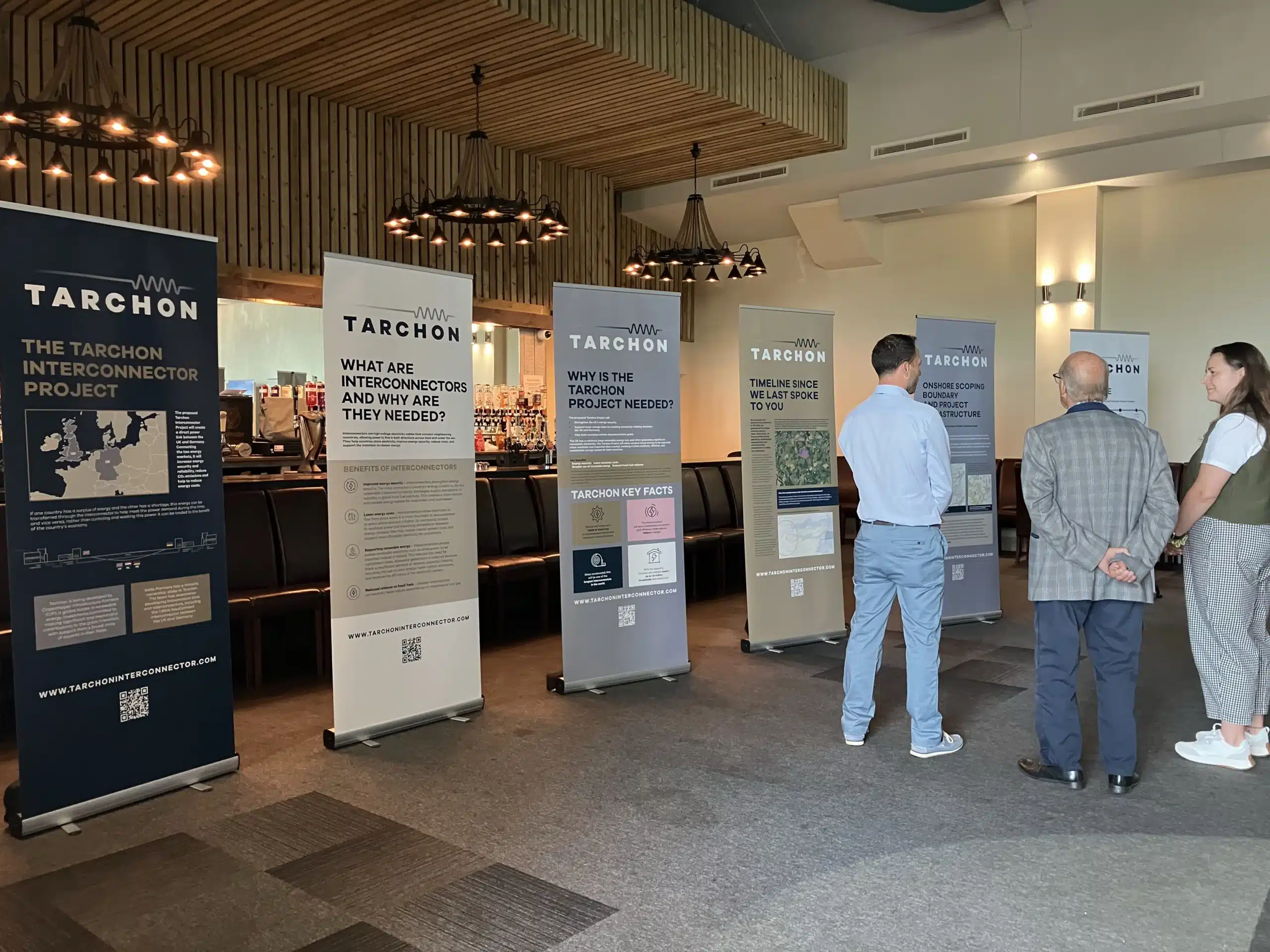
Interconnectors like Tarchon are high-voltage electricity cables that connect neighbouring countries, allowing power to flow in both directions across land and under the sea.

They help countries trade electricity to secure more affordable electricity from other markets, improve energy security, reduce costs, and support the transition to cleaner energy. Learn more.

Technical diagram showing the Tarchon interconnector route between the United Kingdom and Germany with capacity specifications.

The Tarchon project is designed to strengthen energy security, enhance grid resilience, help reduce energy costs and support the transition to a low-carbon energy system in Europe.

Tarchon will allow up to 1.8GW of electricity to move between the UK and Germany in both directions.

The interconnector will be a combination of onshore and offshore cables approx. 760km in length.

Once constructed, this will be one of the longest interconnectors in the world.

With its capacity, Tarchon can reliably supply up to 1.9 million households with electricity.

CIP Logo

Copenhagen Infrastructure Partners

Tarchon is being developed by Copenhagen Infrastructure Partners (CIP), a global leader in renewable energy investments committed to making significant and meaningful contributions to the green transition.
What Is Tarchon?

  • Interconnectors are cross-border electricity cables that directly link the power grids of two or more countries. They make an important contribution to the stability of the power supply by balancing supply and demand across international borders. This increases security of supply, while at the same time supporting the use of renewable energies more efficiently.
  • A central advantage of interconnectors lies in their ability to handle load peaks or overcapacity flexibly, avoiding energy wastage. If individual countries temporarily produce more electricity than they themselves consume, the surplus (that may be delivered at a lower cost) can be exported via interconnectors – and vice versa.
  • Interconnectors consist of high-voltage lines that can run both on land and underwater/under the seabed. For connections across large bodies of water – for example, between the European mainland and the UK or Ireland – high-capacity subsea cables are used. Submarine interconnectors mostly use High Voltage Direct Current (HVDC) cables to minimise losses over long distances. This requires converter stations at each endpoint, where electricity is converted from the High Voltage Alternating Current (HVAC) used in national grids, to HVDC for transmission; and vice versa.

Interconnectors are high-voltage electricity cables that connect neighbouring countries, allowing power to flow in both directions across land and under the sea. They help countries share electricity, improve energy security, reduce costs, and support the transition to cleaner energy. The key benefits of the Tarchon Interconnector are:

  • Improved energy security – Interconnectors strengthen energy security. The more connected a country’s energy system is, the less vulnerable it becomes to energy shortages, supply disruptions, or volatility in global fossil fuel markets. This creates a more resilient and reliable energy system for consumers and businesses.
  • Lower energy costs – Interconnectors allow electricity to flow from areas where it is more abundant or less expensive to areas where demand is higher. By increasing access to available power and improving competition between energy markets, they help reduce overall system costs and support more affordable electricity for consumers.
  • Supporting renewable energy – Interconnectors enable excess renewable electricity, such as wind power, to be exported instead of wasted. This reduces the need for curtailment (when renewable generation is reduced because there is insufficient demand or network capacity), helping maximise the use of clean energy, lower carbon emissions, and improve the efficiency of the electricity system.
  • Reduced reliance on fossil fuels – Greater international connectivity helps reduce dependence on imported oil and gas.
  • Tarchon comprises of both onshore and offshore infrastructure. The offshore project elements include approximately 620km of subsea cabling, which will traverse UK, Dutch and German waters; with approximately 120 km of onshore cabling in Germany (in comparison to approximately 20 km onshore in the UK). In this way, a direct, high-capacity electricity connection is created between two important European energy markets.
  • In the UK, the Tarchon interconnector will come onshore in the Tendring peninsula, Essex, with a proposed landfall zone being considered south of Harwich. Approximately 15 km of underground cables will travel from landfall to connect with the Tarchon converter station which will transfer the HVDC power to HVAC power. The Tarchon converter station will then connect with approximately 5 km of underground cable to the proposed National Grid East Anglia Connection Node (EACN) substation.
  • Between the UK and Germany, the Tarchon interconnector crosses Dutch territorial waters.
  • In Germany, the cable runs through the Exclusive Economic Zone (EEZ) of the Federal Republic, then through the 12-nautical-mile zone and finally beneath the island of Langeoog through the Wadden Sea.